Showing posts with label Technology. Show all posts
Wednesday, May 13, 2009

HP Introduce economic Newest Server


Hewlett-Packard (HP) introduced back ProLiant Server newest series, which was named HP ProLiant G6. This is called the server is able to bring twice the performance compared to previous generation.HP ProLiant G6 range the energy savings, virtualization, and automation. This innovation coupled with a bid komperehensif services, to re-define the economic value of the server.
HP Proliant Server G6 is available in 11 types, and divided into 3 forms of the standard include: tower (ML series), rack (DL series), and the blade platform (BL series). This is the biggest launch in the history of HP ProLiant HP.

"Now this customer need is the return of investment capital from their servers," said cin cin, iss Director, HP India in a press conference in the Mid Plaza, Intercontinental Hotel, Jakarta, Tuesday (12/05/209).In addition, HP ProLiant G6 is able to bring the best innovations in saving energy, virtualization and services easier for customers to do various things with a minimal number of devices. ProLiant servers G6 is offered with the price range USD 999 - 2105 depending on specification.

Read More......
Saturday, May 2, 2009

Easily check E-mail New in Gmail


This application is simple, but it is quite useful for you who often lazy to open the e-mail application in the browser or are coming forward an e-mail is important. According to the Google, you can use the Gmail Notifier to check for new e-mail automatically every two minutes, monitor the content of short up to 30 e-mail, select the sound notification when receive new e-mail, and use the Gmail application as the default e-mail you .After download this application, the icon will be present in the envelope of your system tray and can be used to show information about the new e-mail what you have not check. Just follow the steps below.

1. Download Gmail Notifier is 292KB in size by clicking the button http://toolbar.google.com/gmail-helper/notifier_windows.html . In addition to Windows (2000 or XP), this application can also be used by users of Mac OS 10.4 +.2. Install the Gmail Notifier nongol up window that asks you to enter a user name and password. Fill them as you are logging in to Gmail. Check box if you do not want to enter information repeatedly.
3. Congratulations! Now you are ready to use the Gmail Notifier. Please find the envelope icon in your system tray (the bottom right of screen). Navigate the cursor to it, and you will find information about the condition of your Gmail inbox. For example, if there is no new e-mail that comes in, information will appear "No unread mail." Meanwhile, if any, will be notified to the amount of electronic mail that is on there (in the example image: "21 unread Conversations").

4. Please right-click the icon in the envelope. Gmail to open an application automatically in your browser, select menu . Meanwhile, if you want to check for new e-mail without opening a browser, click .

5. After clicking , will appear short in regard to each new e-mail inbox in the appropriate order, such as sender name, e-mail headers, and content of the e-mail along two lines of text. If there are 21 new e-mail in your Gmail inbox, it means 21 will also appear short info of each e-mail in turn on the far right bottom of the screen. But even though you do not click this option, short info will still be displayed in real time each time a new e-mail into the inbox or notify e-mail are not open when you turn on your computer. 


Read More......


Yesterday AMD recurring year-to-40.
As if to commemorate the age, a graphics processor ATI Radeon HD 4770 also launched a new. PThis product is aimed at the desktop PC market.ATI Radeon HD 4770 is special because it utilizes the most sophisticated manufacturing process at this time, 40 nanometer. Memory technology to its latest, which is GDDR5, which provides higher levels of data performance for a faster game, including hardware support for third-generation game-game DirectX 10.1, as Battleforge, HAWX, Stalker Clear Sky and Stormrise.

Thanks to the technology Unified Video Decoder (UVD 2.0) second-generation of AMD, users can enjoy video playback is smooth, the images are clear, colors are sharp for all HD content, including Blu-ray disc. While the support for HDMI, picture-in-picture (PIP) and technology-the latest HD audio technologies like 7.1 surround sound, users can enjoy the entertainment experience with the quality of Cinema nan impressive at home.Claimed as the best performing and most efficient electric energy in the class, this graphics processor dibandrol the price of less than U.S. $ 109. One of the MSI is already implemented.

Read More......


With a unique shape, sparkler, and consists of a variety of colors, this collection of stars moving to the spiral that looks like underneath a point. Gambar yang menawan ini diambil lebih dari 100.000 tahun cahaya oleh teleskop ruang angkasa Hubble. Captivating image that is taken more than 100,000 light years by Hubble space telescope.This telescope shows a group of stars with one another. Image is issued to commemorate the 19 years Hubble launch.
Shower cosmic stars, gas, and dust are called by the U.S. Agency Antariksa (NASA) system ARP 194. Orange light on the top of the carpet as a galaxy is believed to be in the process ignites in a collective group of stars.


At the bottom of the collection of stars, there are areas with a bright blue color which is the current cluster stars' super '. NASA called this cluster as a shower of young stars. Picture a 'point' at the bottom of the form of stars resembling a question mark is a single spiral galaxy.Since was launched on 25 April 1990, Hubble has made more than 880,000 observations and documenting the 570,000 images of 29,000 objects more space. Hubble's position outside the earth's atmosphere allow monumentalize image almost without interruption lighting.
Next month, the plane re-alik space vehicle equipment that Atlantis was launched for the mechanical treatment Hubble still operated up to 5 years.Hubble replacement, James Webb, was launched in 2013.


Read More......


In Windows Vista, you can get experience outside of the normal Windows Vista wallpaper. Desktop in Vista can display the video as a wallpaper it. This feature is called Windows Dream Scene.
To get a great experience, the condition you must have Windows Vista Ultimate Edition with the original hardware that supports aero graphics. To ensure this, you can click the right mouse on the desktop and select Personalize.In the Personalization window, select the option Window Color and Appearance option, and select the Open classic appearance properties for more color options. Color scheme option make sure you use the Windows Aero option.

Next, follow these steps:
1.Click [Start]> [All Programs]> [Extras and Upgrades]> [Windows Ultimate Extras]. 

2. Make sure your computer is connected to the Internet.
3. On the Windows Update window, click the [Check for updates].
4.Give the check option on the Windows Dream Scene preview, and download updates from Microsoft site.

5. Windows DreamScene Once downloaded and installed to your system, restart your Windows.

6.To activate the Windows Dream Scene, right-click the mouse on the desktop and select Personalize. In the Personalization window, select the option [Desktop Background].

7. Change the position of Location with Windows Dream Scene Content Pack. Then select the option that is in the video there and see the results on your desktop. Amazing is not it?

8.If you want to use another video file, you switch to Video location or click Browse to specify the location of the video file on your hard disk. If you are not satisfied with the one example file provided Microsoft, to repeat steps 1 to 5 to download video files of seven other wallpaper.


Read More......

While adoption in the U.S. still languishes, China's nuclear power is flourishing

One of the biggest controversies in the environmental community is the topic of nuclear power. Some see it as the best short-term hope for clean, affordable alternative energy. Others are fearful of the waste that is associated with older reactor designs. Despite modern reactor designs recycling much of the spent fuel and being built with safer designs, these fears remain. 

The net result is that despite a couple pending applications, the U.S. is stuck with aging nuclear reactions, which indeed play to critics worst fears -- lacking much of the safety and waste recycling of modern designs.

Elsewhere, though, times are kind to the nuclear industry. China, in particular is looking to join France and Japan in providing a large portion of its power from nuclear energy. The nation, which currently relies heavily on coal power, is including nuclear development in a diverse program which also includes massive solar and wind power growth.

Concrete was just poured at the site of a new reactor in Sanmen, China, built by the Westinghouse Electric Company, The Shaw Group Inc., China's State Nuclear Power Technology Corporation, and the Sanmen Nuclear Power Company of China National Nuclear Corporation. The reactor will be the first of four 1,100 MWe reactors built.

The new reactor, the Westinghouse AP1000, is an extremely advanced design which focuses on modularity and automation, as well as safety and optimum fuel use. It is classed as a Generation III+ reactor and is the only such reactor to receive Design Certification from the U.S. Nuclear Regulatory Commission (NRC).

In total, the four reactor project will cost the nation approximately $8B USD. However, it will put them in a position of nuclear leadership, with no other nation currently employing this reactor design, the latest from Westinghouse. Westinghouse President and CEO Aris Candris states, "Completion of concrete pour is a major milestone that visibly moves the Sanmen project from the design and discussion stage to the construction stage. More importantly, by getting this project underway on schedule, we are further helping to ensure that baseload electricity generation will begin at this plant as intended in 2013."

Some Chinese feel less than comfortable about the new reactor, though, stating that their country's people are being used as test rats for unproven designs (source in Chinese). Regardless, construction appears geared to continue as planned.

The U.S., despite strong opposition, in coming years may roll out an even more advanced reactor design, with Georgia Power Company reaching an agreement late last year to construct two Revision 16 reactors in Vogtle, Georgia. There are, in total, twelve such pending Combined Construction and Operating Licenses (COLs) filed for, though the go ahead from government regulators still remains. The proposed plans may have to survive heavy legal pressure from anti-nuclear groups if they hope to advance. Thus the status of the U.S.'s nuclear future remains significantly more questionable of that of China. 


Read More......


Verizon plans to allow users of rival services to use Hub

Across the country, the number of people using traditional landlines for their home phone service is dwindling. Many consumers are finding in the tough economy that home phone service can be disconnected and mobile phones used exclusively.

Shedding the home phone line is something that many consumers find appealing, but the providers of landline phone service are looking for ways to halt the progression to an all-wireless society. One of the ways Verizon is looking to lure people back to using home phones is with home phones that offer some of the capabilities we associate with smartphones.

The Verizon Hub is a home phone that features an internet-connected base that offers users access to V Cast entertainment services, messaging, and email among other features. Those features are common on many mobile phones today, but are new for the home phone. The big catch for the Verizon Hub is that along with features of a smartphone, it also gets some features of smartphone plans. The device costs $199.99 and requires a 2-year contract.

Verizon has announced today that it plans to offer an application store for the Hub, much like the App Store for the iPhone. The Hub app store would open the market up for third-party developers to offer programs for the Hub expanding its usability. One example of possible application for the Hub is Internet radio.

Verizon also says that it is working to remove one of the most restrictive requirements for using the Hub -- that Hub users must be Verizon Wireless customers. Verizon's John Gravel said, "We're in the process of getting rid of that restriction. Why would you limit anyone from using this?"

The bigger issue in analyst's eyes is that the Hub is expensive -- it costs $199 to buy, there is a two-year contract, and the service costs $34.99 per month. In the economy today that sees people shedding home lines altogether to save money, increasing the cost of the landline is going to be a hard sell.

Forrester analyst Charles Golvin said, "It's a tough time to be marketing a device and service like this. The first order challenge is to explain to consumers why this is an improvement over a home phone ... why it's worth paying $35 a month on top of their broadband bill."

Many consumers can access the same services that Verizon is talking up for the Hub via devices already in the home like smartphones and computers. Simply adding these common features to a home phone seems to be of dubious value.

One significant drawback to the Hub is that customers of rival providers like AT&T and Sprint could be prevented from sending and receiving text messages between the Hub and their mobile phones. Verizon is betting that the app store for the device will be enough to draw attention back to the home phone. That is a big bet and one that Verizon is likely to lose.

The device has been on the market since February 1 and Verizon won’t offer firm information on how many have been sold. All Gravel will say is that demand is tracking with expectations.


Read More......

None of the bidders for the national broadband network met the requirements, so Australia will build its own network

In many parts of Europe and Asia, broadband speeds on wired and wireless networks are much faster than the speeds that American consumers have available. The U.S. has plans to use the wireless spectrum vacated by analog TV broadcasts to help fix the broadband availability issue, but it will be years before most of the new networks are up and running on the spectrum.

Other countries around the world are also working to make broadband connections faster and available to more of the population. Australian Prime Minister Kevin Rudd made an announcement today that none of the five bidders for the national network for broadband were able to meet the needs of consumers.

Australia has been taking bids for a national fiber optic network for a while. Among the bidders were Telstra and Optus, two of the largest networks in the country. With none of the five bidders meeting the needs of the national fiber optic network, Rudd announced that the Australian government and private industry would be investing $30.6 billion USD over the next eight years in a speedy fiber optic network that will include fiber optic cable connected to homes, not just to the street corner telco boxes.

By providing the majority of the $30.6 billion investment, the Australian government will be the majority owner of the fast network when it is fully installed. Private sector investment will be limited to 49% of the network costs to ensure the government is the majority owner. Plans for the network call for download speeds of up to 100 Mbps and the network will be operated independently of the Telstra and Optus networks.

Rudd says that at the peak of construction the new network will provide 37,000 jobs, a significant boost to the economy during the global recession. When complete, the fiber-to-the-premises network will run to 90% of the homes and business in the country with the additional 10% being served by speedy wireless and satellite connections good for up to 12 Mbps. The initial investment from the government will be $4.7 billion and the government will sell its interests in the network within five years of completion.

Analyst Lauren Holt said, "The investment by the Government creates an alternative to Telstra's fixed-line network over time, effectively re-nationalizing part of the fixed-line industry in Australia."

The new network will mean that Telstra will have less of a chokehold on internet access in Australia and the company is expected to fight the government in courts to try to prevent the new network from accessing its existing network of copper wire. Some analysts say that the network could be delayed by five or ten years as Telstra fights a long legal campaign. However, the Australian government says that it will change legislation to prevent Telstra from harming the project and preventing the fast network from being installed.

Australia's planned 100 Mbps network is fast, but in Japan the J:Com network runs at 160Mbps, making it significantly faster than what Australia has planned. At the same time the speeds for broadband downloads are going up, many providers are setting caps on the download limits that offset some of the usefulness of the faster platform. In the U.S. Time Warner is rolling out metered internet access to some parts of the country.

Read More......


What recession? RIM is doing great

In a sign that the economy may be improving, Research In Motion, the makers of BlackBerry smartphones, has announced record sales and revenue for the fourth quarter of their fiscal year ending February 28, 2009.

RIM shipped approximately 7.8 million BlackBerry devices in the fourth quarter and approximately 26 million devices during fiscal 2009. Around 3.9 million net new BlackBerry subscriber accounts were added. As of the end of February, the total number of BlackBerry subscriber accounts was approximately 25 million.

Revenue from the fourth quarter of fiscal year 2009 was $3.46 billion. This is up 24.5% from $2.78 billion in the third quarter, and up an astounding 84% from $1.88 billion in the same quarter of last year.

Net income for the fourth quarter was $518.3 million, or $0.90 per share diluted, compared with net income of $396.3 million, or $0.69 per share diluted, in the prior quarter and net income of $412.5 million, or $0.72 per share diluted, in the same quarter last year.

The revenue breakdown for the quarter was approximately 83% for devices, 12% for service, 2% for software and 3% for other revenue.

Revenue for the fiscal year ended February 28, 2009 was an impressive $11.07 billion despite a sluggish economy, up 84% from $6.01 billion last year. For the fiscal year 2009, net income was $1.89 billion, or $3.30 per share diluted, up 46.3% over fiscal 2008.

"We are very pleased to report another record quarter with standout subscriber growth that speaks volumes about the early success and momentum of our new BlackBerry products,” said Jim Balsillie, Co-CEO at RIM.
 
“RIM experienced an extraordinary year in fiscal 2009, shipping our 50 millionth BlackBerry smartphone and generating $11 billion in revenue. Looking ahead into fiscal 2010, we see exceptional opportunities for RIM and its partners to leverage the investments and success of the past year to continue growing market share and profitability."


Read More......
Monday, October 13, 2008

Five Best Windows Firewalls

Connecting your laptop to the local coffee shop's Wi-Fi without a good firewall and thinking you're secure is like using a condom with thousands of holes in it and calling it safe sex. Your antivirus application is a good start, but if you want to make sure you're computer is safe while you're connected to the internet, a solid firewall is a must. Earlier this week we asked you to share your favorite Windows firewall, and today we're back with the five most popular answers. Keep reading for a closer look at the five best Windows firewalls, then cast your vote for your favorite.

Comodo Firewall Pro (Freeware)


Comodo Firewall Pro is a powerful, free firewall utility. The application's simple, clean interface belies its power, but make no mistake: Comodo is an excellent firewall packed with advanced options. In addition to the firewall, Comodo also comes packaged with an anti-malware tool called Defense+. If all you want is the firewall, be sure to select that option during installation.


ESET Smart Security (Shareware)


ESET Smart Security comes from the same company that makes NOD32, one of the five most popular antivirus applications. ESET Smart Security includes the NOD32 Antivirus along with a firewall and anti-spam filter. As a full-service solution, ESET Smart Security isn't cheap at $60, but a 30-day trial is available. Like NOD32, Smart Security is a powerful tool with a small memory footprint.


ZoneAlarm Free Firewall (Freeware)


ZoneAlarm is a free software firewall from a company called Check Point. Not only does ZoneAlarm detect inbound intrusions, but it also lets you set per-application limits for outbound connections—meaning you can stop Google Chrome or iTunes from phoning home whenever they want, for example.


Your Router's Built-In Firewall


Despite our request for a software firewall, many of you were still adamant about sticking with the firewall that's built into the router you're using on your home network. Fact is, if you don't use your computer outside of your home, you don't necessarily need a software firewall—and you don't have to run a separate application eating up RAM to get great firewall protection. However, as soon as you and your laptop leave the safety of your home, your laptop has essentially no protection if you don't set up some sort of software firewall. So while your router's firewall may be great, just remember: It can't follow you out the door.


Windows Firewall

Arguing that it gets a bad rap because it's a Microsoft product, many of you are perfectly happy with the default Windows Firewall. It's built directly into Windows, runs quietly in the background, and blocks suspicious attacks without requiring you to install any third-party software.
Now that you've seen the best on the block as chosen by your peers, it's time to

Read More......
Monday, May 19, 2008

Get Vista's Best Features in XP


Despite the fact that most of you prefer XP to Vista and would rather Microsoft extended XP's shelf-life, several new and improved features available in Vista would be great to have in XP. This new functionality may not be enough to get you to switch to Vista, but that doesn't mean you're out of luck. Let's take a look at a few ways you can incorporate Windows Vista's best features into your current XP PC for free.
We're going to focus on Vista's small and large features that are missing from XP, separated into three categories: applications, functional, and aesthetic (e.g., transparency is aesthetic, the new start menu search is functional). This list is not exhaustive, but it does cover the features readers feel make Vista worth it.

Bring Vista's Best New and Improved Apps to XP
First, aside from some of the small operating system improvements we'll go into below, Vista also bundles up a few new and improved applications worth mentioning.

A Better Explorer: Windows Explorer is one of the most improved applications in Vista, thanks to added features like breadcrumb navigation, better file previews, and more. There are a few add-ons that add some of these better functional adjustments to Explorer, but in general XP users might want to consider replacing XP's Explorer altogether with something like Xplorer2 (original post) or significantly beefing it up with a tool like QT TabBar (original post). You can also get that saucy breadcrumb navigation alone with Explorer Breadcrumbs (original post).

Encrypt Your Hard Drive: Some versions of Vista—toward the Ultimate end of the scale—come with a new drive encryption software called BitLocker built in. If you're keen on security and encryption but you want to stick with XP, check out the free, open source TrueCrypt (original post). If you need a little help getting started, check out our guide to encrypting data with TrueCrypt.


Take Quick and Easy Screenshots: PrtScrn has been around forever, but it's never been the most user-friendly way to get a screenshot. In Vista, Microsoft threw in a screenshot utility called the Snipping Tool. Fact is, if better screenshots are important to you, there are gobs of excellent free screenshot apps available for XP like Screenshot Captor (original post), Clip2Net (original post), and Jing (original post), among many others.

Bring Vista's Best Functional Features to XP
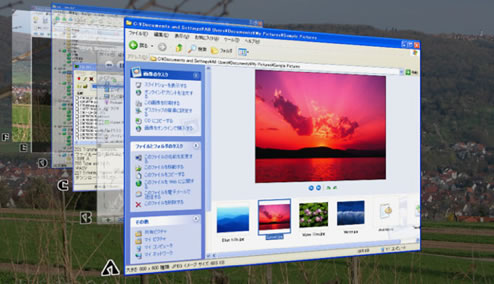
Task-Switching à la Flip 3D: Vista's Flip 3D is like Alt-Tab on steroids, displaying full previews of each window as you move through it. To a large extent it's eye candy, but it can also be really useful in finding the right window when you're switching from your keyboard. Freeware applications like Shock Aero 3D (original post) and WinFlip bring the same 3D shuffling (and then some, in the case of WinFlip) to to your XP desktop.

Integrated Start Menu Search and Launch: Dubbed Instant Search by Microsoft, this new feature adds a search box to the Windows Start menu for quick searching and launching of documents and applications. If you want to port this same functionality to XP, you can do so with apps like ViStart (original post) or Vista Start Menu (original post)—an extraordinarily beefed up version of the Windows Start menu. Then again, if you're not stuck on the notion of a search-and-launch box built directly into the Start menu, you can't go wrong with Launchy or Google Desktop Search.

Replace the Windows Sidebar: Third-party tools similar to Windows Sidebar and Gadgets pre-dated Vista, so you can trade in desktop real estate for the same functionality with SideSlide (original post) or the Google Desktop Sidebar.

Live Thumbnail Previews of Files: Vista does a nice job of providing thumbnail previews to most image files and even text files, and while XP does have similar functionality, it's not as advanced as Vista's. Freeware application Xentient Thumbnails (original post) creates live thumbnails for virtually all images, and if you want a more intimate look at the innards of text and other files without opening them, check out InfoTag Magic (original post).

Speed Up Your System with a Thumb Drive: Windows ReadyBoost speeds up your performance by using a USB thumb drive as system memory, and while nothing beats an actual RAM upgrade, XP users can check out eBoostr (original post) to bring the same functionality to XP.

Streamline Your File Renaming: Microsoft got smart in Vista and changed the behavior when you hit F2 to rename a file, selecting only the name of the file and leaving the extension alone. For a very simple integration of this feature into XP, check out the Better Rename utility. Alternately, if you feel like adding this feature and beefing up Windows Explorer on top of that, you can get the same renaming behavior in Xplorer2 (original post) or QT TabBar (original post).

Taskbar Window Previews: If you like how Vista offers handy little thumbnail previews of windows when you hover over their taskbar item, freeware application Visual Tooltip (original post) brings the same goods to XP.


Give XP that Vista Look

Ultimately, despite all the little feature improvements Vista can throw your way, a new operating system's biggest selling point is often the eye candy—in Vista's case, Aero. There are a lot of tools available that can help you theme XP to look more like Vista, though often users of such applications see mixed results, so proceed at your own risk.
Probably the most comprehensive XP-to-Vista tweaker is the Vista Transformation Pack, which transforms everything from the Start menu and Control Panel to icons.
For a less full-on approach, you could try out skinning utility Uxtheme Patcher with one of several themes from art web site deviantART (like this one or this one) to make XP look and feel more like Vista.
Isn't There More to It Than That?
There are surely some under-the-hood changes in Vista that you won't get from these simple upgrades, but let's be honest: You care about the features, not the underlying code. And since you can get most of Vista's new features from the comfort of XP—and you can stick to XP as a quick, resource-light alternative to Vista—it looks like most of you won't be changing horses anytime soon.
If there's a Vista feature or an XP app you love that wasn't included in this list, let's hear about it in the comments. While you're getting the goods of Vista in XP, you may also want to take a look at how you can get the best of Firefox in Internet Explorer.

Adam Pash is a senior editor for Lifehacker who really only likes XP for its snazzy Media Center improvements. His special feature Hack Attack appears every Tuesday on Lifehacker. Subscribe to the Hack Attack RSS feed to get new installments in your newsreader.

Read More......


Microsoft Research releases astronomy application WorldWide Telescope, software which offers "terabytes" of detailed telescope images of the night sky for exploration right on your desktop. Zoom, pan, and explore the solar system, galaxies and more using WorldWide Telescope. The BBC reports:
Collections include pictures from the Hubble and Spitzer telescopes, as well as the Chandra X-Ray Observatory. ... "Users can see the X-ray view of the sky, zoom into bright radiation clouds, and then cross-fade into the visible light view and discover the cloud remnants of a supernova explosion from a thousand years ago," explained Roy Gould, a researcher at the Harvard-Smithsonian Center for Astrophysics.


Check out WorldWide Telescope in action after the jump.

Via Gizmodo, here's a demo of WorldWide Telescope at the TED conference back in February.

Read More......
Friday, January 18, 2008

Poisoned websites attack visitors


Thousands of small web shops have been unwittingly poisoned with malicious code that infects PC users who visit.

Security experts said the sophisticated attack had succeeded on a larger scale than many other similar attacks.

Once installed on a Windows machine the malicious code steals passwords, browser data as well as login names for bank accounts and online games.

The attack is proving hard to defend against for both sites being hit and PC users who are caught out.

Big hitter

Security researchers at ScanSafe, Finjan and Secure Works separately discovered the nest of poisoned websites. Estimates of how many sites have been enrolled into the attack vary. ScanSafe said it knew of about 230 but Secure Works and Finjan believe the total could be as high as 10,000.

Yuval Ben-Itzhak, chief technology officer of Finjan, said it had been following the attack since early December when it noticed an increase in the number of attacks using poisoned websites.

"It's safe to say that there are thousands of these out there," he said. He added that it was hard to get an accurate picture of just how many had been hit because security firms had limited resources to scan all potential targets.

Writing on the ScanSafe blog Mary Landesman said many of the poisoned sites were small "mom and pop" web shops rather than large web retailers. Despite this, she wrote, many had large numbers of visitors because they did well in web searches for particular products and services.

Sites enrolled by the ongoing attack include trade papers, travel firms, ad brokers, estate agents, butchers, hotel booking sites and car spare specialists.

Although all the websites that have become poisoned hosts use the same server and remote administration software, researchers have struggled to spot all the ways they are being compromised.

"We know some of the methods," said Mr Ben-Itzhak, "they are trying to exploit known vulnerabilities in open source content management software that the sites are using."

Spotting the attack code on a site was very difficult, he said, because every time a new user visited the code got a new, random five character name. If a visitor returned the malicious code identified them and did not launch a second attack.

Open Windows

Simon Heron, managing director of security firm Network Box, said: "It looks like the rootkit type technique that we have been worried about for the last two or three years. It's very clever."

A rootkit hides itself deep inside an operating system in an attempt to avoid detection.

Mr Heron said the code injected on the websites scanned the machine of any visiting Windows user to see if any one of 13 separate vulnerabilities were present.

It looked for vulnerabilities in browsers, instant messaging programs, document readers and media players, he said.

The code installs a small trojan through any one of these loopholes then lies dormant until a user types in data that it is interested in - such as login names for online banks or games such as World of Warcraft.

As yet the trojan installed on a PC is not recognised by many widely used anti-virus programs.

Philippe Courtot, founder and head of security firm Qualys, said small web shops and companies were increasingly becoming a target for criminally-minded hackers.

"Small businesses do not have the money to protect themselves," he said.

He added that hosting firms who owned and ran the servers on which these firms place their websites, viewed security as something extra they had to do rather than build it in.

"Hosting companies, for them today, adding security is a cost," he said.

Story from BBC NEWS:
http://news.bbc.co.uk/go/pr/fr/-/2/hi/technology/7193993.stm

Read More......
Monday, January 14, 2008

Warning on stealthy Windows virus


Security experts are warning about a stealthy Windows virus that steals login details for online bank accounts.

In the last month, the malicious program has racked up about 5,000 victims - most of whom are in Europe. Many are falling victim via booby-trapped websites that use vulnerabilities in Microsoft's browser to install the attack code. Experts say the virus is dangerous because it buries itself deep inside Windows to avoid detection.

Old tricks

The malicious program is a type of virus known as a rootkit and it tries to overwrite part of a computer's hard drive called the Master Boot Record (MBR). This is where a computer looks when it is switched on for information about the operating system it will be running.

"If you can control the MBR, you can control the operating system and therefore the computer it resides on," wrote Elia Florio on security company Symantec's blog. Mr Florio pointed out that many viruses dating from the days before Windows used the Master Boot Record to get a grip on a computer.

Once installed the virus, dubbed Mebroot by Symantec, usually downloads other malicious programs, such as keyloggers, to do the work of stealing confidential information. Most of these associated programs lie in wait on a machine until its owner logs in to the online banking systems of one of more than 900 financial institutions. The Russian virus-writing group behind Mebroot is thought to have created the torpig family of viruses that are known to have been installed on more than 200,000 systems. This group specialises in stealing bank login information.

Security firm iDefense said Mebroot was discovered in October but started to be used in a series of attacks in early December. Between 12 December and 7 January, iDefense detected more than 5,000 machines that had been infected with the program. Analysis of Mebroot has shown that it uses its hidden position on the MBR as a beachhead so it can re-install these associated programs if they are deleted by anti-virus software. Although the password-stealing programs that Mebroot installs can be found by security software, few commercial anti-virus packages currently detect its presence. Mebroot cannot be removed while a computer is running.

Independent security firm GMER has produced a utility that will scan and remove the stealthy program. Computers running Windows XP, Windows Vista, Windows Server 2003 and Windows 2000 that are not fully patched are all vulnerable to the virus.

Story from BBC NEWS:
http://news.bbc.co.uk/go/pr/fr/-/2/hi/technology/7183008.stm

Read More......
Wednesday, January 9, 2008

Copying CDs could be made legal


Copying music from a CD to a home computer could be made legal under new proposals from the UK government.

Millions of people already "rip" discs to their computers and move the files to MP3 players, although the process is technically against copyright law.

Intellectual property minister Lord Triesman said the law should be changed so it "keeps up with the times".

Music industry bodies gave a cautious welcome to the proposals, which are up for public consultation until 8 April.

The changes would apply only to people copying music for personal use - meaning multiple copying and internet file-sharing would still be banned.

Owners would not be allowed to sell or give away their original discs once they had made a copy.

Sales concerns

"To allow consumers to copy works and then pass on the original could result in a loss of sales," the proposals warn.

UK music industry body the BPI said it supported the move to clarify the law for consumers, but warned that any changes should not damage the rights of record companies.

The Association of Independent Music (Aim) said the proposals did not go far enough - pointing out that CDs could become obsolete in the next decade.

It said that, once CDs are replaced, the law could be misused to "open the floodgates to unstoppable copying", adding that it would like to see copyright holders compensated when music was copied.

Lord Triesman said the proposed changes would explore "where the boundaries lie between strong protection for right holders and appropriate levels of access for users".

The proposals also suggest schools and libraries should be given greater flexibility in how they use copyrighted material like CDs and DVDs, and suggests parodies of songs and films could be made exempt from copyright law.

The consultation follows the Gowers Review of Intellectual Property, which recommended that aspects of the intellectual property system should be reformed.

Story from BBC NEWS:
http://news.bbc.co.uk/go/pr/fr/-/2/hi/entertainment/7176538.stm

Published: 2008/01/08 12:07:30 GMT

© BBC MMVIII

Read More......

The National Institute of Science and Technology has set the requirements for its Cryptographic Hash Algorithm Contest

The National Institute of Science and Technology (NIST) recently announced a competition to create a new hash algorithm. Hashes are algorithms that convert blocks of data into a short fingerprint to use in message authentication, digital signatures, and other security applications.

The competition comes as advances in algorithm analysis make the current SHA-1 and SHA-2 family standards more vulnerable. NIST plans to have the new hash algorithm, which will be known as Secure Hash Algorithm-3 (SHA-3) augment the standards presently specified in the Federal Information Processing Standard (FIPS) 180-2, Secure Hash Standard. Federal civilian computers are required to use these standards, and many in the private sector adopt them as well.

In particular, the SHA-1 family has been seriously attacked in recent years. Due to the success of recent attacks, the NIST changed its policy for federal agencies, recommending in March of 2006 that it cease use of SHA-1 as soon as possible and move to SHA-2. The move to SHA-2 is required of all agencies as of 2010, with some exceptions for minor use such as message authentication codes, key derivation functions and random number generators.

NIST's goal is to provide greater security and efficiency for applications using cryptographic hash algorithms. A tentative timeline (PDF) was presented at the Second Cryptographic Hash Workshop held in August of 2006. The timeline was adjusted to take into consideration such practical things as other workshops to minimize travel for interested parties and the FIPS 180-2 reviews scheduled for 2007 and 2012.

A draft set of requirements for acceptability, submission and evaluation criteria were published in January of 2007 and after a three month open comment period, were revised. The actual requirements for the competition (PDF) were published to the federal register on November 2, 2007.

The entire process for the SHA-3 competition is similar to that of the past Advanced Encryption Standard competition that was held by NIST in years past.

FIPS 180-2 specifies five cryptographic hash algorithms: SHA-1, SHA-224, SHA-256, SHA-384 and SHA-512. Superseding FIPS 180-1 in August of 2002, FIPS 180-2 is already five years old, and with advances in cryptography and computing power, it's hard to be surprised that those algorithms have come under heavy attack.

Source:Daily Tech

Read More......
Tuesday, November 27, 2007

IBM Lands Atop Supercomputer List


IBM leads the TOP500 for the fourth consecutive year

IBM is once again number one for the 30th installment of the TOP500 supercomputer list. The newly upgraded BlueGene/L System -- a joint venture between IBM and the Department of Energy's Lawrence Livermore National Laboratory -- took top honors with a Linpack benchmark score of 478.2 TeraFLOPS.

The BlueGene/L has held the top spot since November 2004 and shows no signs of relinquishing its crown any time soon. The 478.2 TFLOPS performance of BlueGene/L marked a significant improvement over its pre-upgrade performance six months ago of “only” 280.6 TFLOPS.

The BlueGene/L which took top honors features 104 racks (64 pre-upgrade). Each rack contains 1,024 nodes with 2,048 IBM Power processors.

The next closest supercomputer, a BlueGene/P headed by Forschungszentrum Juelich, was a distant second with 167.3 TFLOPS. Rounding out the top five was an SGI Altix ICE 8200 based at the New Mexico Computing Applications Center (126.9 TFLOPS), an HP Cluster Platform 3000 BL460c run by India's Computational Research Laboratories (117.9 TFLOPS) and another HP Cluster Platform 3000 BL460c run by the Swedish government (102.8 TFLOPS).

IBM led all competitors on the TOP500 list with 232 systems (45 percent representation). Four of the IBM systems were in the Top 10, while 38 were in the Top 100.

Of the 500 supercomputer systems that made the TOP500, 354 used Intel processors. AMD processors pulled in with a second place showing of 78 systems, while IBM's Power processors were featured in 61 systems.

The BlueGene/L's significant gains in computing power over a short period of time lead many (including IBM) to speculate that the petaflop barrier will be crossed in 2008. “Petaflop computers promise exponential breakthroughs in science and engineering by providing predictive and highly detailed simulations,” said IBM in a press release. “Earthquake simulations, for example, could show building-by-building movements of entire regions along the San Andreas fault, improving future designs of earthquake-resistant structures.”

The massive amounts of computing power provided by these supercomputer systems are channeled by a diverse field of institutions and companies.

"This sort of looms over what they are doing," said Herb Schultz, marketing manager for IBM's Deep Computing division. "You have financial institutions running these huge financial modeling applications and you have oil and gas companies looking for resources in obscure places."

IBM expects that its new supercomputer systems to be introduced next year will find a home in a variety of fields including weather forecasting, energy exploration, and auto and aerospace engineering.

IBM is also putting the finishing touches on its “RoadRunner” supercomputer which will feature Power processor cores backed by Sony’s Cell Broadband Engine which has gained an enormous amount of fame in the past year. The petaflop machine will be delivered to the U.S. Department of Energy’s Los Alamos National Laboratory in the latter half of 2008.

Source:Daily Tech

Read More......
Thursday, November 1, 2007

GMail 2.0 Coming Soon


GMail 2.0 is coming soon to your friendly local internet.

Google announced some news at its Analysts Day, which may excite some -- it will be releasing a completely rewritten, optimized and improved version of GMail. The version's goal is reportedly to raise customer satisfaction to 70 percent.

Such a high satisfaction rate, particularly for a free email service would be very impressive. Many internet services, including the internet service itself enjoy woefully low satisfaction and general customer antipathy.

GMail has been driven by aging Java-script which will now be brought up to speed. The new version dubbed "GMail 2.0" has two main goals: faster service and better contact management.

Initial testers reported the test version felt noticeably faster and more responsive, particularly in contacts management. They report a new contacts screen, as well as that the chat can now not be hidden (at least in the trial version).

Another improvements is that contact pictures can be transferred directly from Google's Picasa web albums, all server-side, to reduce bandwidth and processing expenses on the user side.

Google recently made headlines when it switched to the superior IMAP protocol, an unexpected move for a free internet service, as reported at DailyTech. IMAP support should be almost completely rolled out to GMail users by now.

Expect to see GMail 2.0 rolled out sometime this year or early next year. The update is recognizable by a "newer version" option appearing in the upper right hand links in the mail window. Be sure to comment if you received this update, as Google has not announced a hard date for the rollout.

Google currently features over 4 GB of storage per account, which makes it one of the most generous providers in terms of storage space.

Google has been breaking ground with many new initiatives, including its Google News, the Google Lunar Challenge and the Unity Project -- a trans-Atlantic cableline. It did recently get its heart broken by Facebook, when it got rejected for Microsoft. However, it is unconcerned as it has a deal with Myspace.com and several other networks, and hoards of loyal GMail users, who will soon be enjoying an improved version of their favorite email service.

Read More......


New sockets, chipsets and architecture en route from Intel before 2009

Nehalem will likely be the most aggressive processor architecture in Intel's portfolio since the original Pentium. With the launch of the Core architecture, the company announced its tick-tock strategy: design new architecture, then shrink the process node. Rinse and repeat.

Tick-tock is alive and well as Intel's corporate roadmap reveals additional details about its desktop iteration of 45nm quad-core Nehalem, dubbed Bloomfield.

Nehalem will be fundamentally different from the Core architecture for no less than two reasons. The company will move the memory controller from the core logic on the motherboard to the processor die. This tactic has been a cornerstone for the AMD K8 architecture since 2003.

In addition, Nehalem will also feature a new bus interconnect, currently dubbed Quick Path Interconnect. This new interconnect behaves very similar to HyperTransport, currently used on all AMD platforms since K8.

A new bus and memory controller means a new socket design. Existing motherboards are not compatible with Nehalem-based processors. The new desktop socket, labeled LGA1366, will completely replace the existing LGA775 interconnect.

The company will replace the X38 and yet to be announced X48 desktop chipsets with the Tylersburg chipset family and ICH10 southbridge for these first LGA1366 motherboards.

Corporate guidance also suggests the company will likely ditch all DDR2 support in favor of DDR3, at least on the high end platforms. All Bloomfield processors will feature support three DDR3 channels.

However, not everything is known about Nehalem just yet. Corporate guidance suggests Bloomfield will feature a new revision of Hyper-Threading. Although each Bloomfield features four physical cores, the processor will dynamically allocate additional threads -- Bloomfield computers will detect eight logical cores.

Bloomfield will feature less cache than Intel's high-end 45nm Penryn offerings slated for release between now and Q4 2008. However, unlike the 12MB L2 cache featured on Penryn, the 8MB L3 cache on all Nehalem offerings can be shared between all four on-die cores.

Intel's highest-end Bloomfield processors will feature a 130W thermal envelope. Extreme Edition Penryn processors, the first on the 45nm node, have a thermal envelope that tops out around 136W. Intel's Q9550 processor (2.8 GHz, 45nm quad-core) sports a 95W TDP.

Paul Otellini, Intel CEO, boldly announced that Nehalem as "taped out" at the Intel Developer Forum last September. The tape out designates when a design team has moved from the design to working samples.

At both Intel and AMD, the tape out comes approximately one year before the actual launch date. True to tick-tock, Bloomfield's debut will also come one year after the 45nm node launch, or Penryn.

Read More......
Wednesday, October 31, 2007

NASA wrestles ripped solar panel


Spacewalking astronauts bolted a solar power tower to the international space station on Tuesday, completing an ambitious three-day moving process that ended with elation when the beam's giant solar panels began to unfurl.

Their joy turned to concern, however, when a rip was spotted in the second solar panel.

NASA needs to get the tower up and running to prevent malfunctioning station equipment from delaying the addition of a much-anticipated European research lab.

A massive rotary joint is supposed to make sure the solar panel wings on the right side of the space station are facing the sun. But the gear, which was installed in June, has been experiencing electrical current spikes for nearly two months.

The solar panels on the 17½-ton girder that was installed at its new location Tuesday were folded up like an accordion for the move, and the first one slowly was unfurled as the seven-hour spacewalk wrapped up, gleaming like gold in the sun.

The crew kept spacewalker Scott Parazynski and Douglas Wheelock apprised of the first solar wing's unfurling as they floated back inside. Their reaction: "Wow, that's great," and "Awesome!"

"It's a good day's work right there," Parazynski said.

The astronauts abruptly stopped the unfurling of the second panel, however, as soon as they saw the rip on the edge of the panel. The panel was almost completely unfurled when the rip was spotted. The astronauts beamed down photos of the torn and crumpled section so NASA can analyze them and determine the extent of the damage.

At Mission Control's request, the astronauts retracted the wing just a bit to ease the tension on it.

A spacewalking astronaut found black dust resembling metal shavings inside the motorized joint on Sunday. NASA has limited the joint's motion to prevent the debris from causing permanent damage, but that also limits the system's ability to generate power for the station.

Parazynski spent part of Tuesday inspecting the matching rotary joint that turns the space station's left set of solar wings toward the sun. NASA will examine images he gathered of the perfectly running unit to compare it to the malfunctioning one.

There were no shavings inside the joint, and Parazynski said everything looked pristine.

"It's right out of the shop, no debris whatsoever," he said.

Parazynski and Wheelock guided astronauts inside the station as they used a robotic arm to hook up the beam to the orbiting outpost's backbone. The spacewalkers then began installing bolts to hold the beam in place and connecting wires to provide power.

"Oh I love this job," Parazynski said as they worked 220 miles above southeast Asia. "Beautiful view."

Given the problems with the right rotary joint, NASA needs the power generated by the newly installed solar panels to proceed with the planned December launch of the European Space Agency's science lab, named Columbus.

That lab and a Japanese lab set to be delivered early next year will latch onto the new Harmony module that Discovery delivered last week.

The space agency added a day to Discovery's mission so spacewalking astronauts could conduct a detailed inspection of the troublesome joint. That work is scheduled for Thursday.

To make room for that inspection, managers canceled a shuttle thermal tile repair demonstration that was scheduled for that spacewalk. The test was added to the mission after a piece of fuel-tank foam gouged Endeavour's belly on the last shuttle flight in August.
advertisement

Any repairs to the malfunctioning gear would be put off until after Discovery departs.

Discovery is now scheduled to undock from the space station on Monday and return to Earth on November

Read More......